
Tuesday, October 25, 2016

Who Lives in the Real World?


College can get claustrophobic. You live in a tiny dorm, apartment, or dumpy house, either on campus or within easy distance of it. If you have a job, you probably work as a campus janitor, campus cashier, or campus research assistant. If you're not employed by the school, you don't have far to go to get to work. I go to a good sized school with a gym, health clinic, grocery store, bank, florist, and laundromat on campus. Most of my social outings are concerts, games, and events put on by school clubs or teams. I don't have much reason to leave.
Our lives are compact and consolidated. But are they any less real than those of people who aren't in college?
In high school, "real world" referred to our post-graduation lives. Now I'm in college, and "real world" refers to life after our second graduation. I can't imagine what it's like to get a Ph D. They'd never get to live in the real world. A few months back I ate lunch with a non-student who was waiting for her husband to finish his shift at the cafeteria grill. She did not work for the school. She worked for a security company, and she said she'd learned a lot about alarm systems in her time there, "But that won't be any use in the real world."
Out of state students refer to the world beyond Utah as the real world. Except for the Hawaiians-their real world is the mainland. So far as I can tell, you can never live in the real world, because the real world is wherever you aren't.
So what is the real world, then?
I'm troubled by the idea that the "real world" can only be inhabited by people who work for money. This excludes children and students and paints them as something other than real people. Even high schoolers with after school jobs are caught up in this "unreal people" designation. If children don't live in the real world, what about retired people? What about people with disabilities, the unemployed? And what about stay-at-home moms?
I've heard too many mothers refer to themselves, ashamedly, as "just a mom". I hear women stress that motherhood is a job, the most important job, and not a job that everyone can do right. Can't a woman's work be valued without putting it in the same category as work-for-pay?
For centuries, the world's most popular occupation was farmer, and you had to live on your farm. Father, Mother, Brother, and Sister all worked the family farm. Then the Industrial Revolution came around, and would-be farmers found jobs in cities. Men would wake up in the home and commute by foot or trolley cart to their workplace. Women continued to stay home. This birthed the idea of the domestic sphere-a separate world for women than men. The man's sphere, of course, was valued more, so it was the woman who didn't live in the real world, though the man was the one to leave. My dad always tells me that he doesn't work because he enjoys it, he does it to support our family. If the workplace world only exists to support the home, doesn't the home have a better claim to be the One Real World? Can there really be only one?
So far as I can figure, the real world is whatever corner of the world isn't relevant to your lifestyle or expertise at any given time. This real world notion devalues people of many ages and stages, but especially young people. If a retired office worker, laid off office worker, and the stay at home wife of an office worker can all live in the real world, so should their sons and daughters. 

Sunday, October 16, 2016

My First Protest

Assembling care package materials with other young volunteers outside of Salt Lake City Metro Planned Parenthood
Back in middle school, around the time I started this blog, I was in love with revolution. I listened to music with themes of uprising and victory and watched the Arab Spring unfold on social media. I read histories of labor strikes and the Civil Rights movement and bemoaned being born in a place and time with nothing to protest. I researched issues I was passionate about and expressed my opinions over the Internet, but I wanted the real thing. In my dorm hall last year, I was having a conversation with my hallmates when the topic turned to protest and two of them mentioned causes they'd been involved in back home. As if every high schooler waved a sign at some point. I walked away from that conversation feeling like I was wasting my youth. I write about other teenagers making a difference. Wasn't this the stage of my life where I should be waving signs and crowding courthouse lawns?
Around this time, I started researching abortion and came to feel passionate about the pro-life movement. For a year I researched the science, ethics, and history of the issue. I sent emails, made calls, listened to podcasts, and read all I could to learn more. But only recently did I think to research pro-life groups in my area. I joined a Facebook group and watched the calendar until I found an event that could work with my school schedule.
Today marks the one hundredth anniversary of Planned Parenthood, the largest abortion provider in the US. Groups across the country have gathered this week to protest outside of clinics. Pro-Life Utah organized a protest/service project outside a clinic in downtown Salt Lake City. This location does nothing but abortions, women who want other services are directed to a clinic across town. It is one of two advertised abortion clinics in the state. Together, these two clinics are responsible for around 3,000 preborn deaths a year.
Yesterday morning, I drove from my college town to Salt Lake for my first protest. I was nervous. I went alone and didn't know a soul there outside of interactions on Facebook. I had no idea what to expect. I'd told my parents and roommates I was spending the day on a service project so they wouldn't worry. But what if it got out control?
When I pulled up to the clinic, there were no waving fists or shaking signs. The clinic wasn't even open on Saturdays, so there were no customers to confront. Most of the "protest" was focused on providing for a local woman named Bryonna who has cerebral palsy and is facing pressure from doctors and family members to abort her son. We tied a quilt and collected donations to help her buy disability-friendly baby care equipment. We also pinned blankets, wrote notes, and assembled care packages for other women in crisis pregnancies. No shouting. No banners. No crowds. Not counting the media, the women, children, and men in attendance numbered somewhere around twenty. It was a service project, no different than many I've done for school or church, except for the fact that we were on the lawn of an abortion clinic.
There's something romantic about screaming and shaking posters. And those protests serve a purpose. It's important to raise your voice about the things you value, to let the world see you swarm the public square. But any problem that exists in the real, tangible world needs real, tangible action to solve it, not just the chaos and clamor of people expressing their opinions. Maybe a revolution can be as soft as a baby blanket.
Service is just as important as expression, though not as romantic. When you're young, you romanticize change. But young and old people alike can do good in more quiet ways. At age fourteen, I cheered on Syrian revolutionaries fighting to bring down a tyrannical government. At age fifty, my mother has just decided she needs to learn Arabic. She wants to help refugees because she used to be one herself. In fifth grade, her family moved to Iran for my grandfather's work, intending to stay for five years. The revolution forced them out one year later. My mom was allowed to take a single suitcase and a footlocker on the plane home, but both were lost or damaged in transit. She returned to America with almost nothing. Their house had been leased out for the time they planned to spend in Iran, so they had nowhere to live. But they had advantages this influx of refugees doesn't. They were citizens. They had friends. They could speak the language. My mom went on to major in political science because of her experiences and worked for the government before becoming a stay at home mom. Now she feels called to learn a whole new language.
I guess it's never to late to help people and acquire the skills to do so. We might feel like the glory days are always behind us, but there are battles to fight all around you no matter where you live. You don't need to shake your fist to be a catalyst for change.

Friday, September 23, 2016

Interview with San Francisco Youth Activists

Last month, I talked about a group of San Francisco teenagers that are calling for their city to lower the voting age. I reached out to Vote16SF and had the privilege of interviewing two of their media directors: Joshua Park, age fifteen, and Jessica Eng, seventeen.

Erica Smith: What inspired you to get involved in civic engagement?
Joshua Park: I got inspired to be more civically engaged because I began a community project called the La Playa Park Beautification Project through a group called Generation Citizen about creating positive change in my community. This got me thinking about organizing young people and trying to not be a bystander. I want to work to fight for things I am passionate for.
Jessica Eng: I first became interested in politics and volunteering as a middle schooler. As a student volunteer, I was told to stand at street intersections and farmer's markets and carry a sign for the position or candidate I supported. Some people call these duties trivial, but these small acts gave me a glimpse at civic engagement and jump started my interest in city policy and politics. At the beginning of high school, I joined the Student Advisory Council--a city council with public high schoolers that draft, write, and discuss educational policy for the San Francisco School District. Being constantly surrounded by people who look, speak, and think differently than me has inspired me to work diligently for the students and families in my diverse city.
Erica Smith: If voting rights are extended to sixteen year olds in San Francisco, how will this set an example for other communities?
Joshua Park: San Francisco is not actually the first place to pass this legislation, but it will truly create a healthier democracy and be a light for other cities to follow. Other youth in cities including Washington D.C., Berkeley, Richmond, and Colorado are working diligently on passing similar legislation.
Jessica Eng: If more youth are learning about democracy, voting, and public policy, I believe that they can inspire their communities (whether it be their immediate family, friends, schools, neighborhoods) to also be politically involved. A politically active community is a strong community--it is important to have people show they care about issues that affect them.
Erica Smith: How do you balance your civic engagement work with school, extracurriculars, sleep, etc.?
Joshua Park: To be honest I don’t know, my sleep definitely suffers somewhat but as a youth who is not only part of Vote16SF, but also as a student athlete and a SF Youth Commissioner. One thing to do if I am this busy is not to waste any time and find methods to relax quickly, and for me that's music.
Jessica Eng: Civic engagement as a high schooler does require an immense level of dedication. I also have school leadership and dance program commitments. However, I feel like I am able to balance all my work along with sleep because I budget my time efficiently. I am also not afraid to ask people for help; I know I can’t do every project or act of civic engagement that is available so I make sure to be involved in the ones that matter most to me and that I can contribute to the most.
Erica Smith: Why is it important for older people to be involved in pro-youth causes? Do you think you'll continue to be involved with these causes when you reach legal adulthood?
Joshua Park: I would like to think so, from my experience just because we are young people doing big things somehow discredits the work we are doing. And the same thing happens in life, just because I’m young doesn’t mean that I don’t experience hard things, and when I talk to adults sometimes they cannot understand the life of a teenager in today’s society.  But, I also do think that it is important to represent causes that you are passionate about and make sense.
Jessica Eng: When older people get involved in pro-youth causes, a lot of good can come out of it. First, youth can see the adults as role models and mentors. Secondly, it can inspire youth to also become engaged politically with youth and with their communities when they grow up. I will definitely continue to be involved in youth movements when I get older. In terms of other political issues, I believe that I will continue to fight for gender equality and more environmentally friendly measures.
Erica Smith: How do you think your civic engagement work compares to that of past suffrage movements for women and people of color?
Joshua Park: I think that the focus of those campaigns was equity whereas our campaign focuses on building good habits of civic engagement and voting.
Jessica Eng: The similarity between the three movements is that the people fighting for suffrage feel like they don’t have a say in the government that perpetually affects their life and wellbeing. Presently, San Francisco youth see a plethora of policies that affect students--housing, education, future taxes, etc. We want to have a voice that matters in these issues. On the other hand, the Vote 16 movement is unique in that many youth have grown up in a different world, one that is filled with television, radio, and newspapers. Youth today are more informed than ever and want to contribute to a democracy that they see everywhere every day.
Erica Smith: Aside from the lack of voting rights, what do you believe is the greatest issue or injustice young people face today?
Jessica Eng: Generally, youth struggle with being taken seriously. Youth voting is definitely one way to fight this stigma. On the other hand, I think that more organizations, especially organizations that affect youth directly, will need to take the initiative to recruit student voices. I would like to see more companies reach out to youth and genuinely and seriously consider their opinions.


In the age of social media, teenagers have more resources and motivation than ever to get involved with the causes they care about. Whatever your passions, if teenagers in cities around the country can move towards the right to vote, you can make an impact in your community too. 

Sunday, August 28, 2016

San Francisco Teens Seek Suffrage

Image result for san francisco

In two small Maryland towns, Takoma Park and Hyattsville, youth suffrage activists have pushed the voting age down from eighteen to sixteen. San Francisco aims to be the third municipality to grant voting rights to Americans who are already considered old enough to work, drive, and be tried as adults in a court of law. 
Like their friends in Maryland, San Francisco teenagers only aspire to vote in small scale elections for now, and they won't make it in time for this year's presidential race. Hard work, youth empowerment workshops, and campaigning by the San Francisco Youth Commission put a proposal called "VOTE 16" on November's ballot. If the eighteen and ups support it, high schoolers will be able to cast their votes in municipal, county, and school board elections. Teenagers are raising their voices, but ultimately, it's the adults who will decide if they can be heard.
A common criticism of youth suffrage is that young voters will just give their parents an extra ballot. It might be a legitimate concern in a world where teenagers never rebel against their parents. When sixteen and seventeen year olds cast their ballots in the Scottish independence referendum, 44% voted independently of their parents. 
In San Francisco specifically, teenagers who do align their political beliefs would their parents could give their family not a second vote, but a first one. San Francisco is a diverse city with a large immigrant population. One in three San Francisco Unified School District students have an immigrant parent who could not vote for laws and policies affecting their US citizen children. 
VOTE16SF isn't just about getting teens to the polls. They aim to create adult voters, today and tomorrow. Only 40% of eligible San Francisco adults turned up for last year's election. Young blood could bring more. They want teenagers to come home from civics class and talk politics around the dinner table. They want high school voters to become college voters, and then parent voters themselves. 
If you're interested in donating $16 to the cause (or any amount, really, but I have a hard time resisting the sweet sixteen), or just want to learn more about the teens and ideas behind this proposal, you can visit vote16sf.org.
I can't see any day in my lifetime when sixteen year olds could be guaranteed voting rights across the country. But then again, women at the Seneca Falls Convention were hesitant to push for voting rights because they thought it was asking too much. They wanted to concentrate instead on securing property and child custody rights. Only one teenage girl who attended the convention in 1848, Charlotte Woodward Pierce, lived to see the day in 1920 when she was granted the right to vote. The impossible has to start somewhere. Maybe today's the day.

Saturday, August 13, 2016

Worth More than Gold: Lessons from a Former Teen Olympian

Makayla Maroney lands a vault routine in 2012
"I'm worth more than a gold medal," says Makayla Maroney, who took home a gold medal at age sixteen in the London Olympics four years ago. While two of her teammates, Gabby Douglas and Aly Raisman, conquered Rio this year, Makayla had to watch the games from home.
I only did gymnastics for a few years myself, and I never had any great skill in it, but I've loved following these two sets of teammates because I match up with them in age. I always keep an eye on young celebrities and public figures, though I don't blog about them now as much as I did in previous years.
Earlier this summer, I found a little blue notepad while packing for my travel term. I flipped it open and found it hadn't been touched since I was fifteen years old. It had drafts of blog posts and book reviews (I ran a book blog for several years) as well as topics and titles I wanted to cover in the future. The last thing on it was a to-do list for when I got back home from a family vacation. "Update blog, finish books, watch Olympics, and get ready for school."
On the train ride home from my travel term, I started to make a list of things I'd do in my brief summer before leaving for school again. Then I realized I could just reuse the list I made four years ago. Every item is the same, but now I'm going into my sophomore year of college instead of high school.
Fifteen was a big year for me. It's the year I wrote my first novel. The year I started high school. The year I watched the cops pull a body out of the river behind my house and never looked at life and death the same. And now I'm a full Summer Olympics away from being fifteen. Change sneaks up on you. My daily routine doesn't look much different, but in so many ways I've shifted from what I was four years ago.
Since Olympic time frames seemed like a good unit to measure my own life's progress, I checked up with the three members of the Fierce Five who didn't return for Rio to see how they're doing.
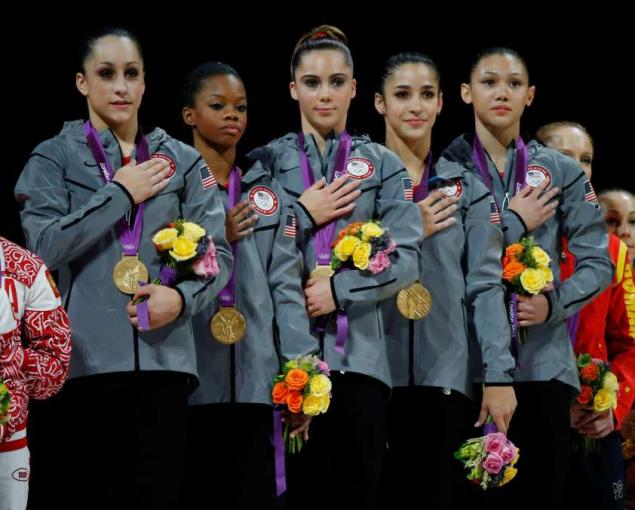
Aly Raisman, Gabby Douglas, Makayla Maroney, Jordyn Wieber, and Kyla Ross
Kyla Ross (I've always had a soft spot for her because we were both fifteen at the time of the Olympics, although she did flips and stuff and I sat on the couch and watched) is attending college at UCLA. Teammate Jordyn Wieber is there with her. And Makayla Maroney? The face that launched a thousand memes? A knee injury took her out of elite gymnastics, but she's doing fine now. She's writing music, something she barely ever had time for as a professional gymnast. Her first single, "Ghost", comes out next month. My favorite thing I found on any gymnast was this interview Makayla gave Us Weekly.

“I lost myself. It was an identity crisis, no doubt. I would go and meet people and they’d tell me, ‘You’re the gymnast.' And I’m like, now that I’m no longer a competing gymnast, it throws people off and that would throw me off. I don’t want to let people down. It was such a big test for me to be like, you know what? No! I’m worth more than a gold medal. I’m worth more than being a gymnast. I am not what I do. I am who I am and I’m what I love.”

Worth more than a gold medal. Most people would be happy to if they could measure their life in gold and just break even.
Makayla has put into words what I've wanted to say for a long time. I've watched plenty of my friends have identity crises. When you're young, your life is in flux, so your identity is vulnerable, and it hinges largely on hobbies. Some people get theirs in high school, but I saw the bulk of it my freshman year of college. When you go away to school, you're uprooted from your family, friends, and hometown. Athletic hobbies go away if you're not good enough to play at the college level and other hobbies disappear because you lose the time. And on top of all that, you're supposed to choose a major. That's the first question people ask after your name. They don't know how to learn who you are without asking what you do with your life. If you don't have a major yet, you're not just a slacker, you're a non-person.
A few months ago, a girl giving a talk at my church shared a story about her eighth grade soccer coach, who never gave her playing time. At first I thought it was ridiculous for her to be whining about playing time in a public meeting five years after the soccer season ended. Then she said, "All I'd ever known was soccer. Now that I wasn't playing, I felt like he'd taken away my identity."
Hobbies are the figurehead of childhood identity. When you hit thirty, people assume you don't have fun anymore and stop asking "What do you like to do?" at get-togethers. But at fourteen, you'd better have something good to say. You aren't working and can't be dating anyone yet, at least not seriously. A hobby is all you've got.
Gymnasts burn bright and brief, and all athletes have to slow down as they grow up, but all hobbies, even the non-athletic ones, fall by the wayside eventually. If age isn't your struggle, time is, or else ability.
One day back in fall semester, my roommate slammed her laptop shut and announced she was going to the library to print off a photograph. Once she had it, she was going to draw.
"What class?" I asked her.
She told me that no professor was forcing her to do it. She just wanted to draw, like she'd been able to in high school, when she took AP art classes.
That caught me by surprise. My roommate was an accounting major, I'd never thought of her as the artistic type. She loved it and was good at it but when college rolled around around it was time to study something else. She didn't even take drawing for her arts elective, opting instead for interior design. But art was a part of her and it needs to resurface once in a while.
My other roommate was a dancer and a Kiwi. I'm convinced hobbies are the biggest portion of most teenager's identities, but I can't skip over the  role race plays in shaping who you are. From birth to age eleven, she lived in New Zealand, surrounded by her people, and even when she moved to America she had her family. Then one day she wakes and she's sharing a dorm with three white girls. She very much wanted to get into our campus's Polynesian dance ensemble, but freshman don't make the cut. So she joined a Tahitian luau group instead and got to dance and connect with more Polynesians that way.
I've had my own crisis. When I was twelve, I watched my older brother receive the Sterling Scholar award in the category of English. The Sterling Scholar program awards full tuition scholarships to any school in the state of Utah, but my brother wasn't interested in either Utah schools or English, so he tucked that feather in his cap and ran off to Berkeley, eventually landing as a Chinese History major. At age twelve I knew I had a love for books and some level of talent for writing. I figured that if he could make it, I should be able to as well.
So I spent the next six years of my life turning myself into a perfect Sterling Scholar candidate. Every conference I attended, every extracurricular activity, and every teacher I sucked up to all tied back into getting that scholarship. I won for my school. That got me a picture in the yearbook and another in the display case by the library. But I only advanced one tier beyond that. Not to state level, where the glory is. And the money.
That's six years of my life I'll never get back.
I turned out okay. All those years were spent developing skills I loved and could use in arenas beyond the Sterling Scholar competition. They built me up. They contribute to who I am. But hobbies and interests will always be part of who I am, not all that I am. As Makayla puts it, "I am not what I do, I am who I am and what I love." Gymnastics will always be a part of her, but it's because of the passion she invested in it, not because of the medals she'll hang on her wall.
Next to holding your moral ground, finding your identity is the biggest struggle of your teenage years. And after you figure out who you are, you have to watch your identity torn down many times and built it up again. Whoever you are, you're worth more than gold medals or scholarships or a spot on the team. You worth an entire you and what that means is evolving all the time. 

Monday, August 1, 2016

Take a Breather

One of my high school teachers had a knack for calculating marriage ages. He'd ask a volley of question-"Are you dating anyone? Got a job? Want a job? Headed to college? How old were you parents? Sisters? Brothers?" and then he'd shoot out a prediction. "You shall wed at age twenty three!"
He claimed he had a 95% success rate. How does he know that? Students grow up, get hitched, and report back to him. Once, long before my sophomore year of high school, he did it for a handful of kids and predicted they'd all marry in their low twenties. Then he told the last girl she'd be thirty two.
The rest of the girls gasped their how-dare-yous, but she tilted her head to the side and said, "No, that's right." She had plans for herself, plans for New York City and art school, and marriage wasn't in the foreground. When she finally reported back to our teacher, she was thirty three and happy with the way her life had gone. 
If you've been reading lately, you'll know I'm currently enrolled in a summer travel term. I finished school the same time everybody did-late April-and originally planned to spend a spring term on campus. But when I found out I'd been admitted into my summer program, I knew I'd need a break. I'd catch a plane the morning after finals and do homework for my new classes during layovers. There would be no time to pack, no time to breathe. I'd have an unbroken chain of school for six straight terms. 
So I dropped by spring classes, canceled my housing contract, and spent seven short weeks with my family. Whenever I tell adults that I finished school at the end of April and started again mid June, they look at me funny. Not because I'm going the extra mile by taking a summer term, but because they think I'm not moving fast enough. They ask what I've been doing with my life, if my parents are supporting me, and how I could possibly not justify spending less than two months away from school if I'm not working. I spent seven weeks fielding these questions at church, family reunions, and lunch get-togethers. I thought the people asking me were ignorant because they hadn't been in college for a while and forgot how school schedules worked. 
But today, I got this question from a professor.  
I'm not sure why it surprises so many people that I scheduled a seven week break from college between August 2015 and May 2017. Is it such a radical idea to have a spring break now? When Malia Obama announced this spring that she would start classes at Harvard in 2017, the "not until 2017" was deemed significant enough for inclusion in headlines. She's graduating in a presidential election year. Is it so shocking that she wants to spend one more normal year with her family? Or spend a year by herself, figuring things out? Or a year in travel? 
Young people are expected to move ahead with their lives at breakneck speed. This simply isn't possible. Sometimes, in my hours of anguish, when I'm scribbling four year plans in the margins of midterm notes with one hand and scrolling through job listings with the other, I think back to some words a church youth leader shared with us a few years back: "You don't have to sing all the verses of your song at the same time." If you did, they'd be muddled beyond comprehension. 
I did a lot from the tail end of April to early June. I caught up with old friends and was a bridesmaid in one's wedding. I trained for and ran a charity 5K. I attended a multi day writer's conference. I went to doctor's appointments that I could not possibly make room for during the school year. I went hiking and boating with my family. In short, I did all the things a person in any stage of their lives might do in any seven weeks of the year. 
But I didn't go to school.
That's two more classes I'll have to fit into a normal schedule instead of having them out of the way a term earlier. And you know what? I'm fine with it. Other students in our program sprinted through spring term just in time to catch the plane. But I know if I did that, I would've had a breakdown and not completed one of those terms. 
Even though I resent the pressure people put on me to sing all the verses of my song, I've caught myself trying to do that same thing to others. My brother typed the final words of his master's thesis last week. I shot him a text of congratulations, and then, fingers hovering over the keyboard, I was tempted to ask him what he was doing next. Was he going to find a job? If so, would he stay in America or head out to China again? What about that girl he was dating before his last trip to China? Can I plan a wedding? What kind of job is he going to get with that Asian Studies degree to support his wife, and are they going to get married now or after she finishes her doctorate? Never mind that so far as I know, they only dated for two weeks. The need to know is always burning.
So cool the flames. 
Over the course of my travel term, I've gotten to know the life stories of people I never would've met otherwise. We're all in roughly the same ages but different stages. I have one eighteen year old friend who graduated from high school with her associate's degree. Another girl dropped out of school at sixteen, got the admission fairy to let her into college, and is now a year and a half into her education. Her eighteenth birthday was two months ago. They're both further along than they're supposed to be at the eighteen, but one took the steep path and one took the detour. 
You end up where you end up. For some people, the right answer is to get married at nineteen. For some it's thirty three. For some people, it's not right to go to college right now, or ever. Some people need to speed through it. Still others will get it done in that same, normal, plodding four year plan. 
When I was a sophomore, I thought my teacher was a some kind of psychic or number wizard, predicting marriage ages with such accuracy. Now I know he was just a normal guy who'd figured out what I'm figuring out right now: that everyone moves at their own pace. I can calculate my friends' marriage ages now. I look at her health, her school goals, and whether or not her mom graduated college, but most of all, I look at her desire to get married. Everyone moves at their own pace, in love and learning and other matters. Life's not about seeing how many verses you can sing at once, but about finding how you fit into the rhythms. 

Saturday, July 9, 2016

Erica's Travel Log, And Why Every Young Person Should See the World

For the last three weeks, I've been traveling the East Coast and Midwest on a study abroad with Brigham Young University. It's a religious school and most of our focus is on religious historical sites, which I'll get around to blogging about later, but today I want to talk about Lincoln.
When I first saw the Land of Lincoln signs dotting Illinois highways, I thought they nicknamed themselves such because they didn't have anything else to brag about. So far as I could tell, Illinois is entirely made up of corn, and Nebraska took that nickname first. Then I got a chance to visit some of Old Abe's stomping grounds yesterday.
Lincoln's tomb is cooler than your tomb.
Since this a youth blog, I'm going to focus on the cool youth related stuff I saw. It's not hard. In addition to being the coolest and most dramatic museum I've ever seen, the Lincoln Museum has a lot to pique a child's interest. 
A few years ago I mentioned Grace Bedell, the eleven year old who wrote Lincoln a letter telling him he was ugly and could nab a few more votes if he just grew a beard. After hearing that story I've always had a special place in my heart for Cleanshaven Abe. 
Me and small, beardless Abraham Lincoln

Small, beardless Abraham Lincoln with a sword, guarding old, bearded Lincoln's tomb
Before and after
Here's Grace's letter:

Dear Sir
My father has just home from the fair and brought home your picture and Mr. Hamlin's. I am a little girl only 11 years old, but want you should be President of the United States very much so I hope you wont think me very bold to write to such a great man as you are. Have you any little girls about as large as I am if so give them my love and tell her to write to me if you cannot answer this letter. I have yet got four brothers and part of them will vote for you any way and if you let your whiskers grow I will try and get the rest of them to vote for you you would look a great deal better for your face is so thin. All the ladies like whiskers and they would tease their husbands to vote for you and then you would be President. My father is going to vote for you and if I was a man I would vote for you to but I will try to get every one to vote for you that I can I think that rail fence around your picture makes it look very pretty I have got a little baby sister she is nine weeks old and is just as cunning as can be. When you direct your letter direct to Grace Bedell Westfield Chautauqua County New York.
I must not write any more answer this letter right off Good bye
Grace Bedell
Abe wrote Grace back with an "I'll think about it", but after he and his beard got elected, he arranged to meet her personally when his inaugural train stopped through her hometown en route to Washington.
Lincoln himself had no daughters, just four sons. His little son Eddie has his first tombstone (he's now entombed with his family) on display in the museum. When they moved him to be with his father and brother Willie, they didn't want a good tombstone to go to waste, so they flipped it and used it as a marker for some of Lincoln's relatives. Eventually it was unflipped and discovered in the 1950's. I've toured several disused graveyards in the past weeks, and it saddens me how many markers are lost to time. The last thing you ever get is a headstone. But we can't all have obelisks, so too many memories weather away.


Eddie's tombstone
Willie and other brother Tad had the run of the White House. Before that, the Lincolns had over eighteen hired girls quit on them during the seventeen years they spent in Springfield. Hired girls helped Mrs. Lincoln keep house and corral the children. They were young women between the ages of thirteen and sixteen, either African American or immigrants from Portugal or Ireland. In theory, this job would let them earn their own money and achieve some independence before they'd go apply their newly acquired domestic skills in marriage. In reality, they ran away and found better jobs. As the older sister of three brothers I can see why. 
Small Boy Fact: If it fits in your hand, it's a ball. If it's longer than your arm, it's a bat. In the background we have Wax Lincoln chilling while his sons play inkwellball. The older brother is on the ground with a broom. 

As a kid, I always loved the artifacts that weren't guarded by glass, and I guess I haven't changed. My favorite exhibit yesterday was one I didn't get a picture of: a metal cast of Lincoln's hands. I rested my own on top of them. They felt fatherly and strong, the kind of hands you'd trust a country in. A businessman in my community once told me that he trusts handshakes over background deals. Everything he needs to know about a man he can learn from his hands. If I could've shaken hands with Mr. Lincoln, I believe he would've had my vote. Well, aside from that whole female under the age of 21 thing. I'm in the same boat as Grace. By the way, Lincoln wanted votes for women, but he had bigger fish to fry at the time. Come back and run in 2016!
The Lincoln Museum has a lot more than old stuff and wax dummies. One of the most striking exhibits is a dark, crooked hall full of grotesque political cartoons drawn by Lincoln's haters. You can hear their whispered gossip from the ceiling as you pass through. That got me thinking. Another hall is full of angry retorts to the Emancipation Proclamation. Holographic faces spew criticism from every possible angle, and they're projected onto mirrors, so you see your own face between theirs. It made me think about the things I take a stand for, about the people who revile me past, present, and future. I want that. I want to be someone brave and bold enough to be worth the tides of hissing tongues. And I want the strength and dauntlessness to be able to stand in the face of those hissing tongues. What do I have today that's worth fighting for? 
Slave mother sold away from her child.
There's actually an entire family on that scaffold, she's staring at her husband. I couldn't get the father in the picture because a white mother and son were standing in the spot I'd need to be. The son couldn't read, he didn't know these were anonymous wax figures, meant to represent so many other families torn apart. He thought there might be some plaque nearby telling the end of their story.
"Mom, did those three people ever get back together?" 
"No, they didn't."
"What about after slavery was over?"
"No, they never got back together again." 
Several months ago, my nineteen year old roommate came home from class and announced that she'd registered to vote. I asked her why she hadn't done that at eighteen, and she said the last election wasn't worth her time. She then plopped herself on her bed and read an article about slavery for homework. When she was done, she sat up, horrified, and wondered aloud if she would have "done something" if she'd lived in the age of slavery. 
No, you wouldn't have opened your cellar as a station on the underground railroad. No, you wouldn't have stood on street corners distributing abolitionist leaflets. No, you wouldn't have helped newly freed slaves learn to read, or to gain other useful skills that would help them be financially independent. How do I know? Because you're not doing anything now.
I didn't tell her any of this, but I asked her what she thought was worth fighting for today, and she said there was nothing. 
I like studying history. It's the story of good people bringing bad things to an end. So many people talk about the present as a cart bouncing downhill, all the good old days behind it. But the world didn't end yesterday. There's still a long stretch of days ahead of us to make things right. 
Travel doesn't just get you out of the house, it gets you out of your everyday thoughts. One day at this museum halfway across the country from my home got me thinking. Thinking about freedom, families, youth, tragedy, memory, standing bold in the face of adversity, and about what I should fight for today. Any one of those topics could be enough for one post. Every young person ought to take some time to see new things and think new thoughts. So get out there! 
I've got another month ahead of me before Boring School starts up again. Let's see where I go next,